
Hi All! 🤗
The Latin word curare means “to take care of.” It’s the root of curator – a person whose work is not to create, but to care. To select, to arrange, to provide context. In a museum, the curator doesn’t paint the paintings. She decides which paintings belong in the same room, and why that room tells a story the individual works cannot tell alone.
I’ve picked this as the topic for this issue, because something has changed on the Web recently, and it changes why a newsletter like this one – and your personal site, and your blogroll, and your links page – matters even more now than it did a year ago.
AI-generated content has flooded the Web. We all see and feel it. You click on a search result, you start reading, and three paragraphs in you get that feeling that the phrasing is just a bit too smooth and too generic. The insights are just a tad too average and obvious. And you feel tricked. Because at first glance, the page looked legitimate. And that’s exactly the problem: for decades, most bad content was easy to spot. You just could immediately tell from the clunky prose or bad footage that something wasn’t worth your time and attention. The good stuff stood out because the rest eliminated itself. But generative AI broke that. Now, mediocre content looks professional from the outside, and the filter we used to rely on — this looks legitimate, so it probably is — no longer works.
And it’s getting worse. By some estimates, more than half of the new content published to the web so far in 2026 was generated by machines. And not only do search results bloat with plausible, competent titles that lead nowhere. Search engines have also started summarising knowledge instead of linking to it. The link – the Web’s most fundamental building block, the thing that connects one human’s work to another’s – is quietly being erased from the experience of finding things online. The search engine no longer says “here, go read what this person wrote.” It now says “here, I’ve already read it for you.” The contract is broken.
So what becomes valuable, in a world like this? Not more content. We are drowning in content. What becomes valuable is someone you trust, saying: This is worth your time. Here’s why.
That’s curation. And it’s not new.
Before Google, before algorithms decided what we’d see, humans curated the World Wide Web by hand. In 1994, two Stanford students named Jerry Yang and David Filo started keeping a list of their favourite websites in a directory. They called it “Jerry and David’s Guide to the World Wide Web.” That list eventually became Yahoo! – one of the biggest companies of the early internet. Its foundation was nothing more than two people picking links they found interesting and organising them into categories.
Directories like Yahoo! and DMOZ, bloggers who linked to what they vouched for, communities that shared bookmarks – this was how we discovered the Web before PageRank. As Jeremy Keith wrote recently: “There was life before Google search. There will be life after Google search.” But Jeremy also saw the comeback coming: the very flood of machine-written noise, he argued, might finally teach us to value human curators again. Robin Sloan, writing in his lab notebook, puts it from another angle: the hard part of the Web was never publishing. It has always been discovery – helping people find new things and find each other in a way that’s healthy and sustainable.
But some of those ways of finding each other never really disappeared. Phil Gyford’s ooh.directory quietly catalogues over 2,000 blogs by hand. Personalsit.es is a directory of over 960 personal websites. Blogs are Back offers a privacy-focused RSS reader with no algorithmic feeds, no tracking, no AI summaries. So if you miss human curation, too, I have good news: the Web we thought we’d lost was waiting all along. And it is now on us to explore even more ways to help each other find new things.
For years, we’ve mainly talked about owning your web in terms of publishing – own your domain, own your posts, own your voice. But that was only ever half of it. The other half is what you point to. Your blogroll. Your /links page. The RSS feed, the monthly roundup, the annotated reading list. The “here’s something worth your time” email you send to a couple of friends. All of that is curation.
So every time you share a link on your blog, every time you write a few sentences about why someone else’s work matters to you, every time you add a new entry to a blogroll or a links page – you are a curator. You are doing what no algorithm can do. You’re saying: I am a person. I read this. I think you should read it too.
In a web full of noise, that act of caring – of curare – might be the most important signal any of us can send.
Thanks for reading Matthias’s little Guide to the World Wide Web. 😉
Links
Here’s another mixed bag of links. Please let me know how you like them! And if you can think of someone who would enjoy reading this newsletter today, feel free to forward along. Thank you!
Don’t let your voice be flattened by the über theme
Dave Rupert – who really wants you to have a blog – with a sharp take on what happens when everyone publishes on the same platform. Over 40% of content on Medium is now AI-generated, and every post looks exactly the same. Dave’s argument: if everyone wears the same uniform, you become interchangeable. The antidote? A personal website that looks like you, talks like you, and has quirks like you.
Don't let your voice be flattened by the über theme - daverupert.com
I want you to have a blog. Despite this being nearly my entire online ethos, one situation I struggle with are design systems and UX blogs on Medium. A lot of them exist. Yet. I have difficulty understanding UX and design professionals in this space who yield their UX and design decisions over to the “everyone looks the same” content silo.
Reading Without the Guilt
Manton Reece, the creator of Micro.blog, has launched a new RSS reader called Inkwell – and it rethinks how we consume the Web. Posts don’t pile up as unread counts haunting you from the sidebar. Instead, they gently fade after a week. Miss something? That’s okay. A weekly “Reading Recap” surfaces what you might want to revisit. It’s curation infrastructure built for humans, not inbox-zero machines.
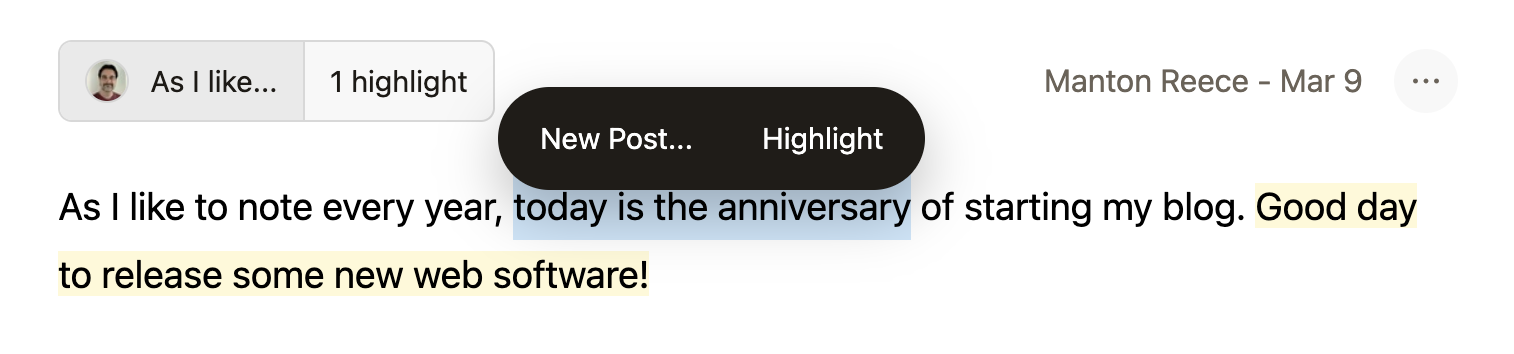
Manton Reece - Introducing Inkwell
Surf – the Open Web
Flipboard has launched Surf, and it’s one of the most interesting things to happen to web discovery in a long time. Surf lets you build feeds that pull from Bluesky, Mastodon, blogs, podcasts, YouTube – anything with an RSS feed or open protocol. The key: you control the sources, you set the filters, you decide what belongs together. Think of it as your own little curated magazine for the open social web. There are already over 10,000 user-built feeds.
In defense of unpolished personal websites
While optimizing her blog’s code, Ana Rodrigues realized that she was removing the very thing that made her site valuable: readability. Minified, bundled, compressed code is fast – but it kills the “view source” experience that taught so many of us how to build for the Web. Ana’s choice: keep the code unpolished, legible, human. In a web increasingly built by machines, an imperfect personal website is a quiet act of generosity.
Oh Hello Ana - In defense of unpolished personal websites
Is it okay to prioritize readability and learning over cutting-edge optimization on personal websites? I believe so. And if we want more people to have a personal website, I think more of us should consider doing the same.
Endgame for the Open Web
Anil Dash with a piece that should make you angry — and then make you build something. His argument: 2026 is the year that decides whether the open web survives. AI bots are scraping publishers into oblivion, sending half a million requests for every single user they send back. Tech publishers have lost over 50% of their traffic. Open APIs are being locked down. Podcasts are being pulled into proprietary platforms. The open infrastructure that made the modern internet possible is under coordinated assault — and the people who could fight back are still carrying on with business as usual. A long, thorough, and urgent read.

Endgame for the Open Web - Anil Dash
A blog about making culture. Since 1999.
The Courage to Stop
Jeffrey Zeldman – godfather of web standards, keeping us informed since 1995 – with a piece so short it practices what it preaches. In a web where anyone can generate pages of text with a single prompt, brevity has become a radical act. Choosing fewer words says: I thought about this, I edited, I respected your time. (I cared.) Six paragraphs. Not one wasted.

The Courage to Stop - Jeffrey Zeldman Presents
Brevity was always a discipline. Now it’s a statement.
The importance of people who care
Speaking of care – it’s not just links and blogs that need people who care. Rachel Andrew connects a Gordon Ramsay documentary to the creeping erosion of craft in software teams. Design systems, editorial style guides, documentation, these all depend on people who obsess over consistency and who are willing to push back. Generative AI can produce design elements and documentation, sure. But machines don’t care. And without someone who does, who has the experience and the authority to argue for quality over speed, what you end up with is slop.
👉 https://rachelandrew.co.uk/archives/2026/04/21/the-importance-of-people-who-care/
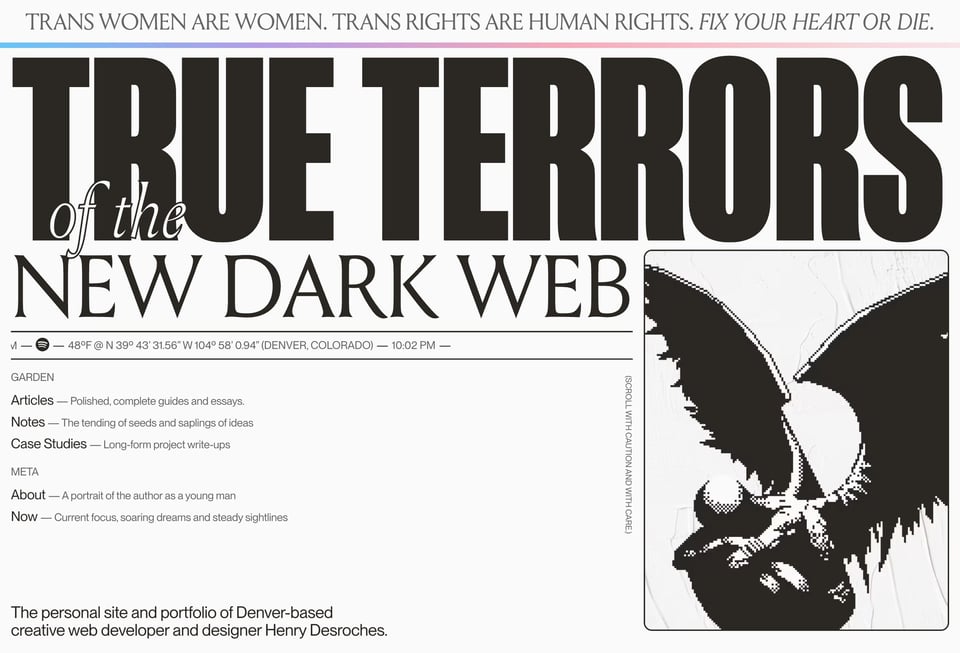
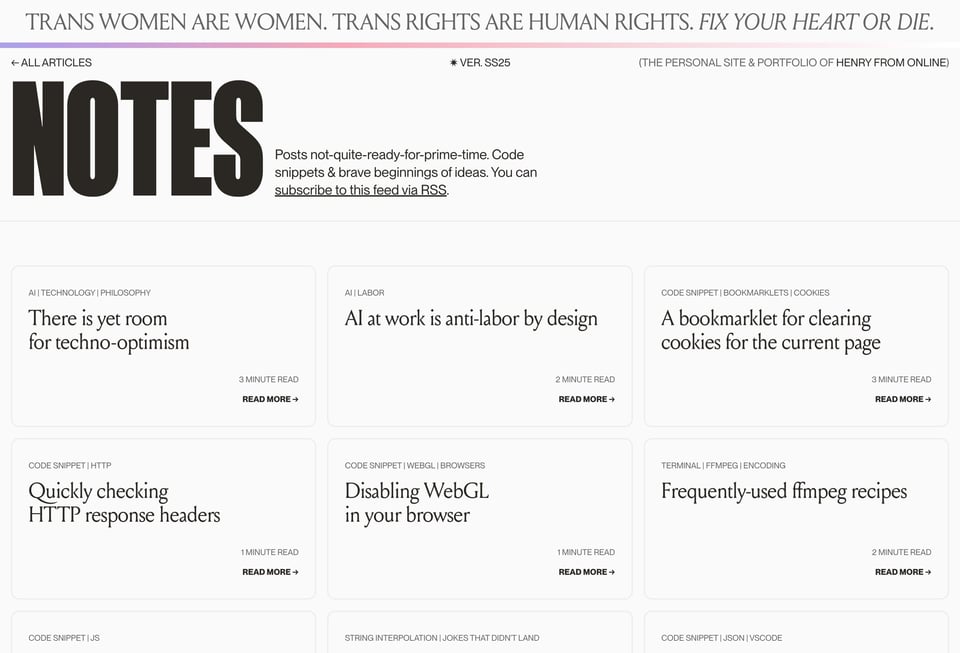
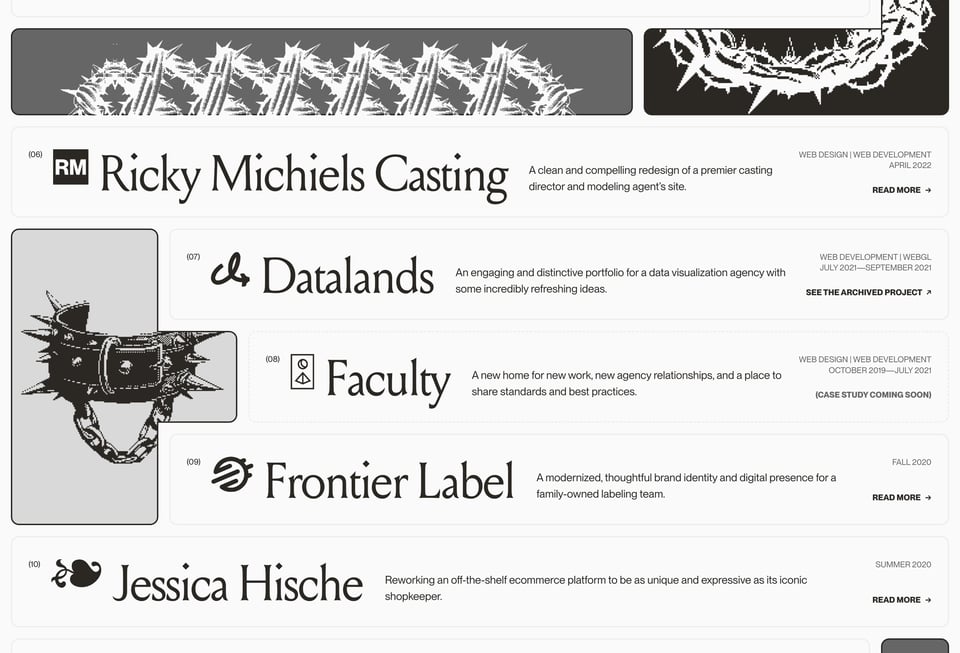
✷ Personal Site of the Week ✷ Henry Desroches == https://henry.codes
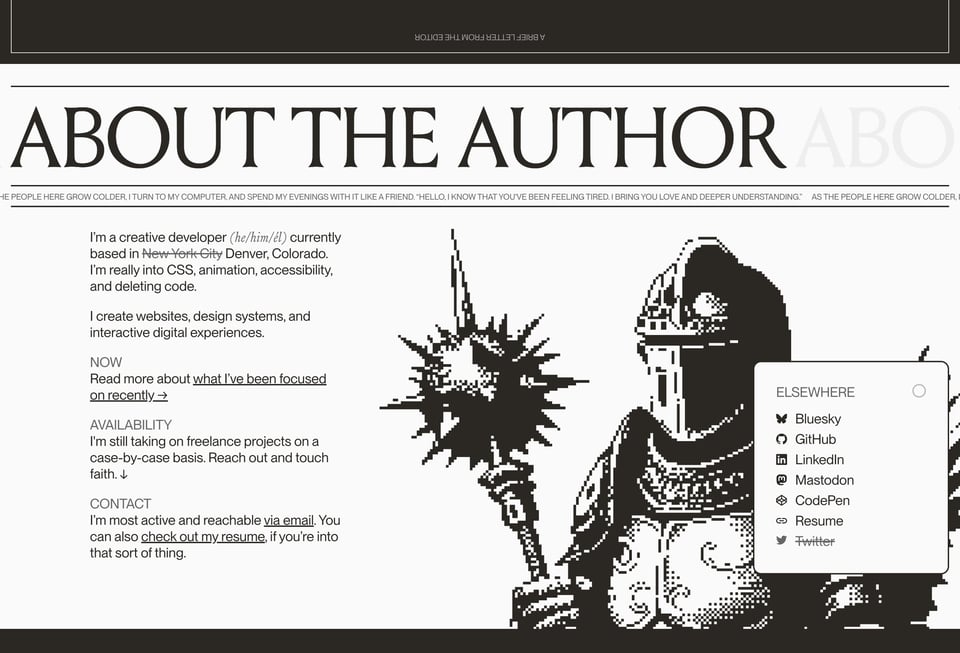
Henry Desroches is a creative developer from Denver, Colorado. His site – subtitled “True Terrors of the New Dark Web” – is a digital garden disguised with the energy of a lovingly hand-stapled gothic zine: black and white pixel illustrations are combined with bold headings and the beautiful Louize (Display) by 205TF. But beneath the atmosphere is serious craft: case studies for Stripe, YouTube, the New York Times, and Jessica Hische sit alongside deeply personal essays and IndieWeb tutorials on collecting Webmentions. Henry is also the co-maintainer of personalsit.es, a community directory of personal websites. And if all of that weren’t enough, every previous version of his site is still archived and accessible – a living changelog of one developer’s evolving relationship with the Web. 🖤
And that’s it for today. How did you like this issue? Which one of the links was your favorite? What do you want more or less of? Do you have any other suggestions on how to improve this newsletter? Hit reply now and let me know.
Cheers and own your web! ☀️
– Matthias
You just read issue #18 of Own Your Web. You can also browse the full archives of this newsletter.


